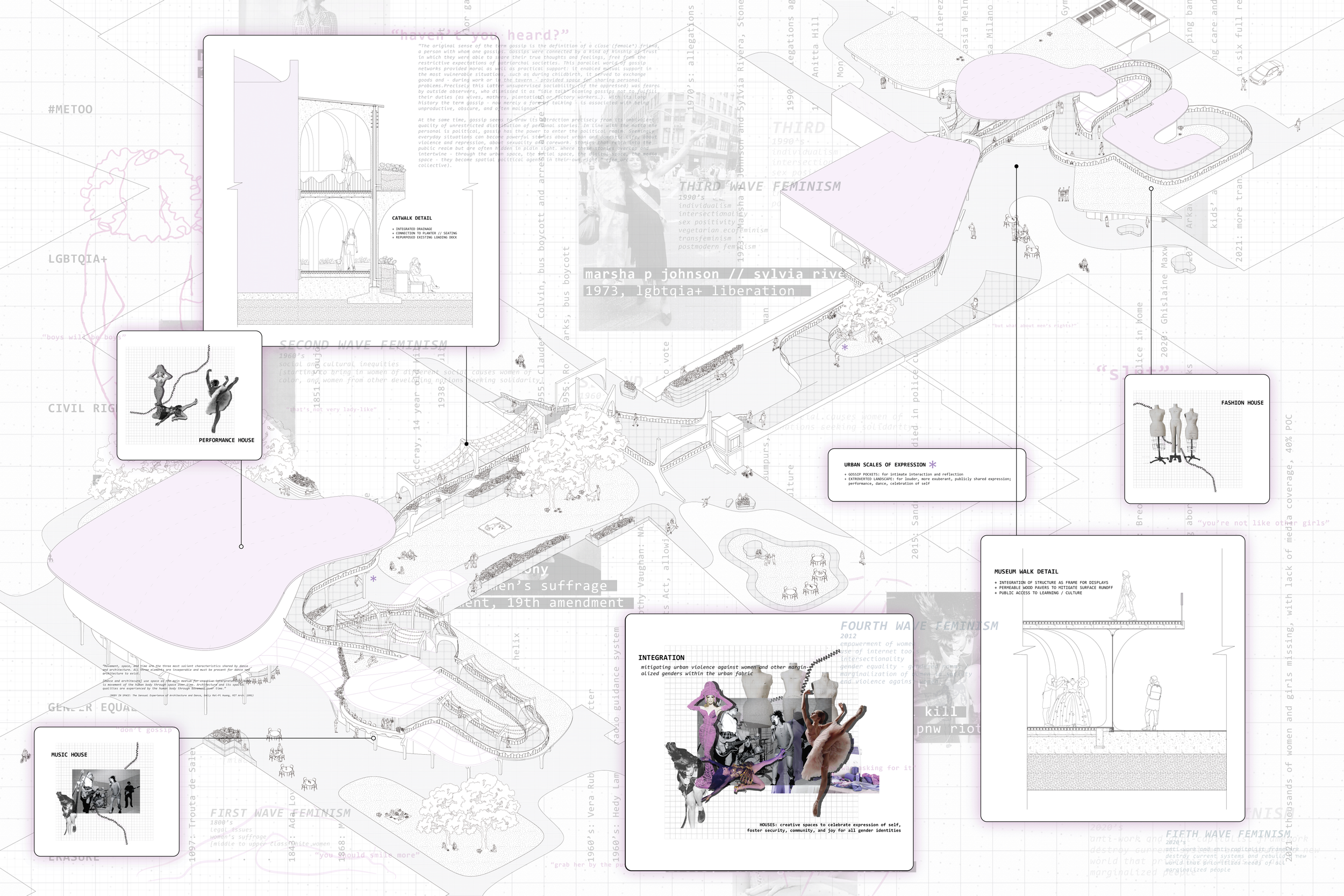
integration board
integration board

In the Urban Violence Laboratory each student was tasked with investigating a subtopic in Urban Violence related to design, architecture, and urban design, in order to propose an architectural project that could prevent, mitigate, or disrupt existing systems of violence.

My thesis is addressing gender-based violence against women and other marginalized genders within the urban fabric.

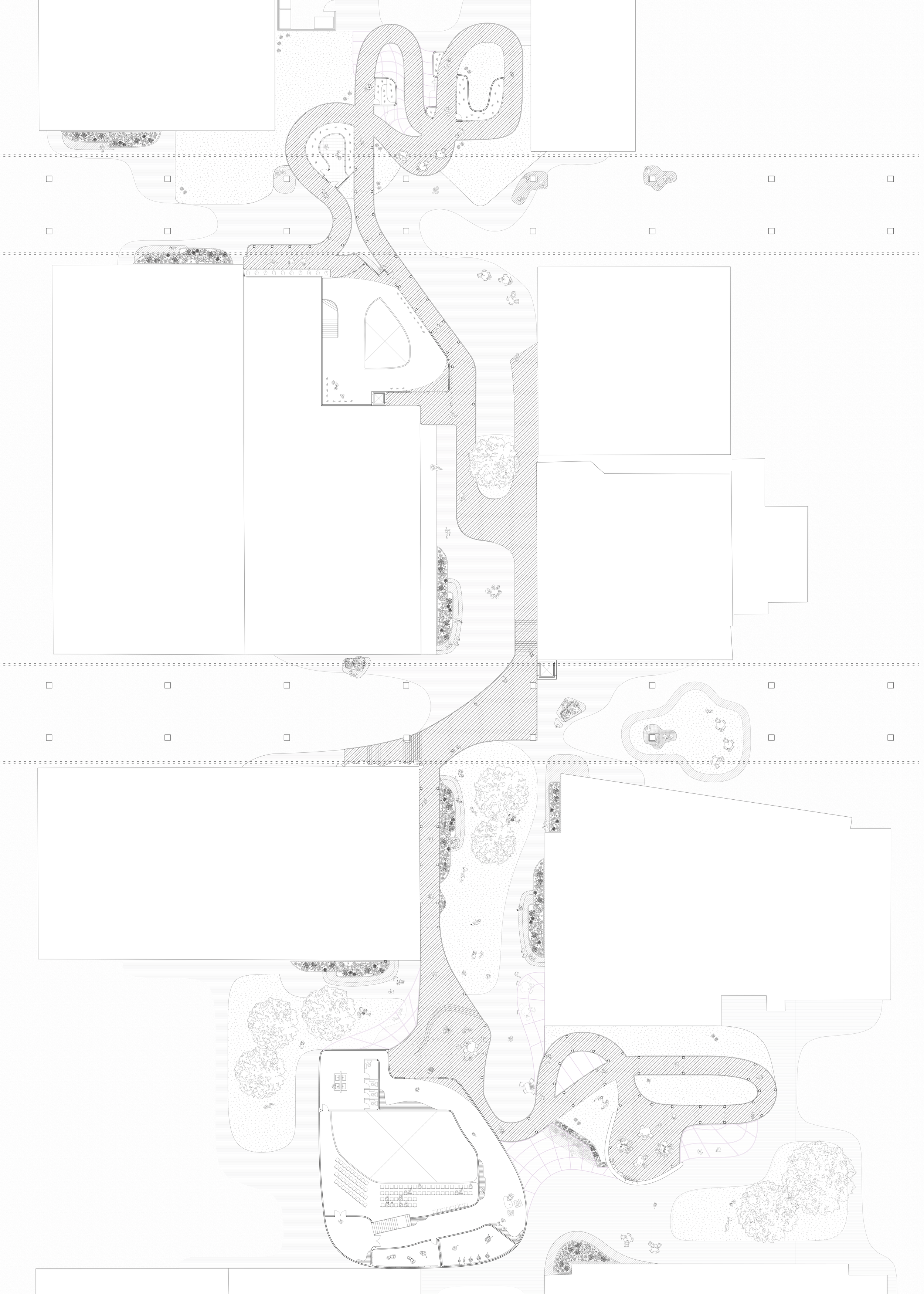
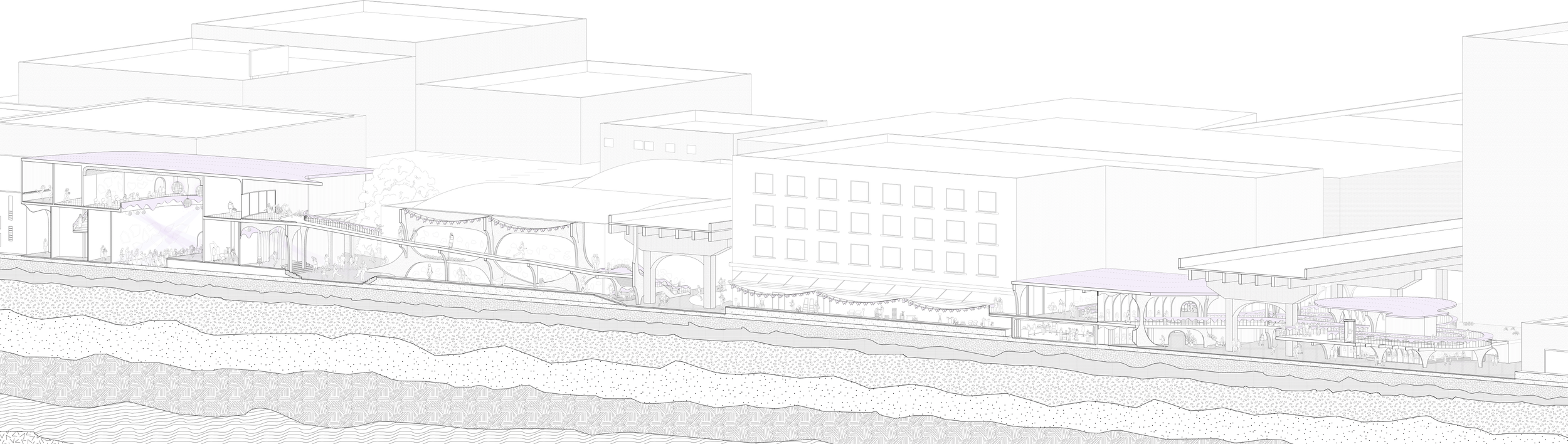
My project is a proposal for a safe street for queer individuals, at the heart of Portland’s Central East Side. Inspired by drag culture and the forming of chosen families, the street is anchored by three “houses:” the fashion house (makers spaces for the sewing and tailoring of costumes), the music house (a recording studio), and the performance house (dance studios/event venue) to support entrepreneurship and provide creative amenities for local artists. The interstitial spaces between these anchors transform existing industrial loading docks into outdoor stages, all connected by an urban catwalk. The catwalk is intended to connect the architecture while hosting introverted and extroverted street activities*, softening bridge infrastructure, and de-paving part of the city, further creating green spaces within the city to foster security, community, and joy for all gender identities.


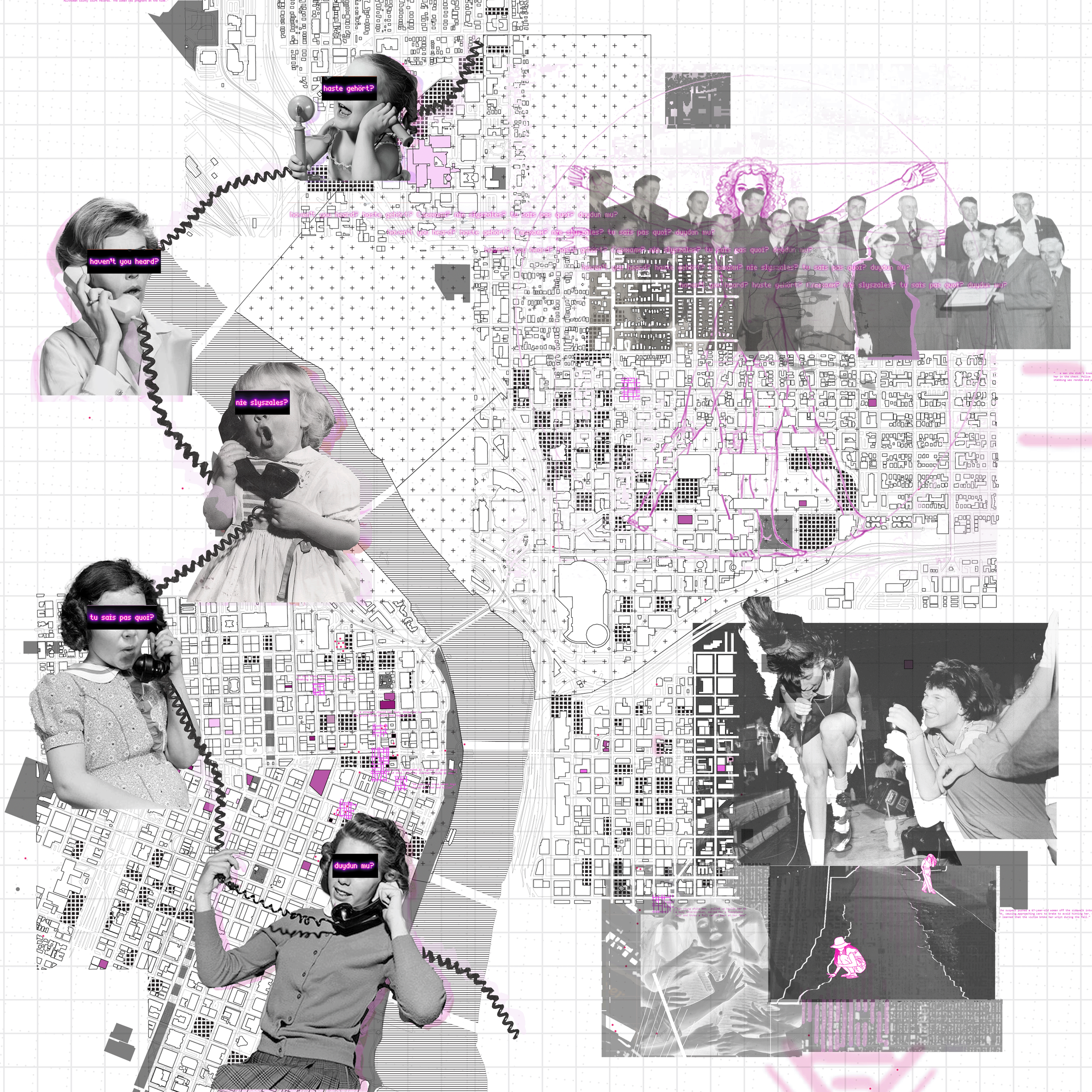
*During my research I was intrigued by an article by fem_arc_collective where I learned about the origins of the term “gossip,” it was originally a term for way that women or other marginalized communities communicated in regards to their safety, survival, and used as a way to build community. Today the term has been stigmatized into something negative, because people outside of these marginalized communities felt othered by the whispers. My project is a host for these more intimate moments “for gossip” as well as extroverted moments; for show, performance, and exuberant celebration of identity.
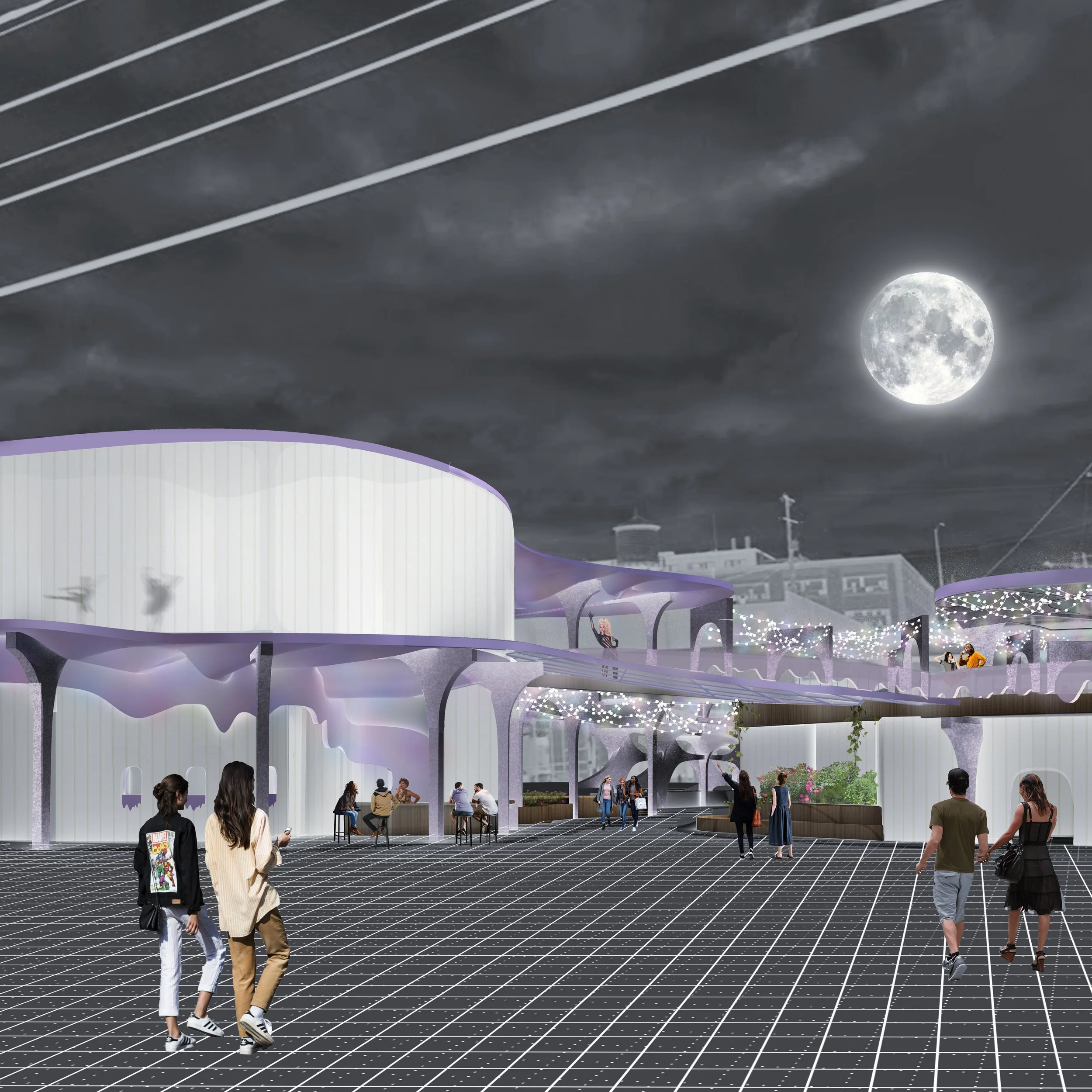
south entry
south entry
Capture.JPG
collage
collage
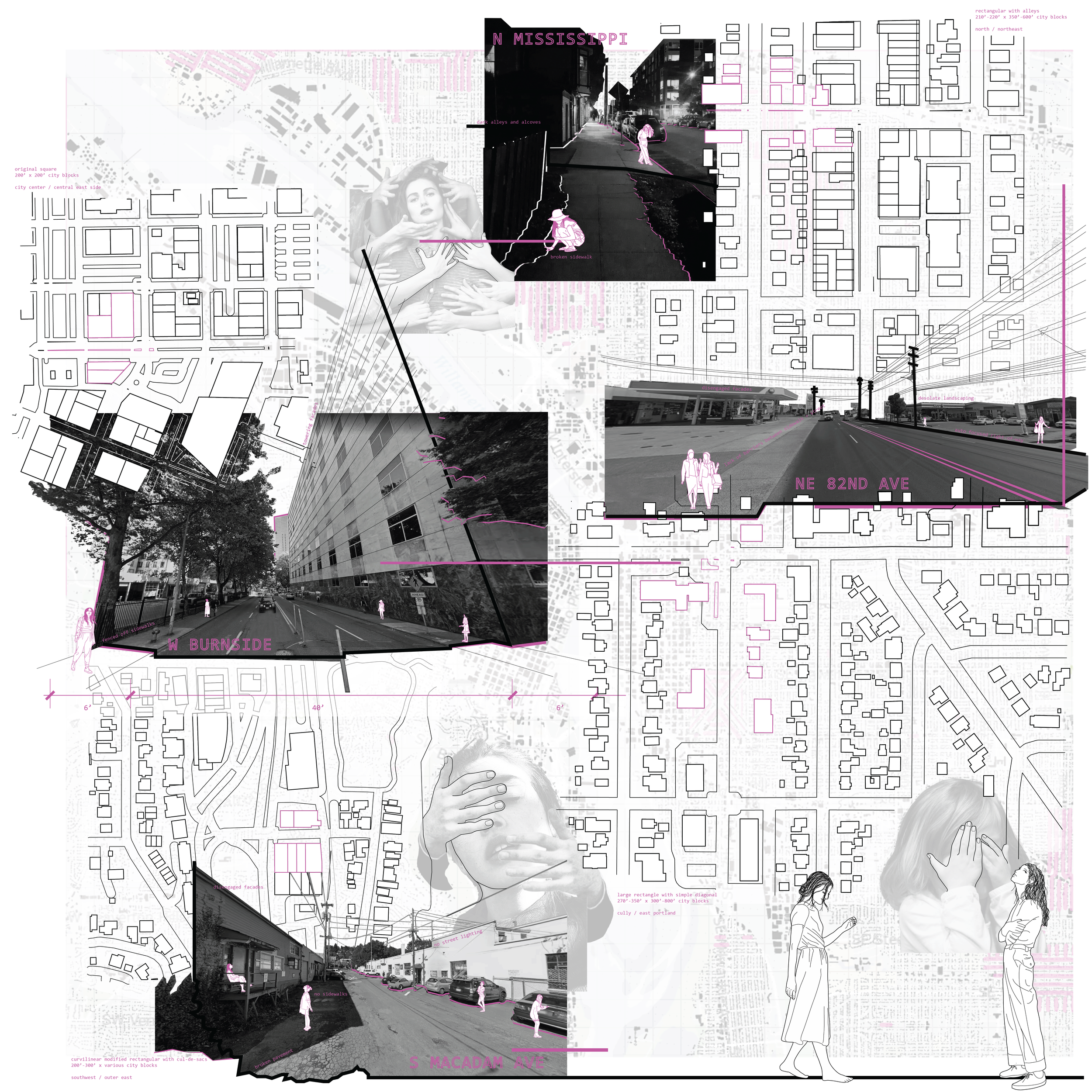
initial mapping excercise

When beginning my research I started looking into things that make the city feel unsafe or unwelcoming as a woman, things like lack of lighting, tall facades without entries, vacant lots, underused space under overpasses and lack of sidewalks/pedestrian infrastructure. This led me to picking my site at the heart of portland’s central east side; on 3rd avenue, spanning the blocks between Morrison and Yamhill.

mural mapping
mural mapping

The Central East Side is notorious for having little existing sidewalks, is extremely car-focused, and has two large overpasses passing over it. Simultaneously, this site has a bright and vibrant art culture: Portland Street Art Alliance has been commissioning local artists to paint murals in attempts to make this the “mural district” within Portland. In addition, the neighborhood has a thriving flea culture and underground art culture. This “underground culture” inspired me to research more into queer art forms such as drag (while now it’s become much more mainstream) historically, queens and other performers come out at night, and drag events (Balls and Pagaents) originated as an underground scene where Black and Latinx gay, trans and queer people developed a thriving subculture, where they could express themselves freely and find acceptance within a marginalized community. Drag balls were considered illegal and taboo to the outside world in the early 20th century, which drove the competitions underground (and also undoubtedly added to their appeal). Attendees were invite only, or knew someone who is there or competing. Drag balls evolved into House Balls, which became the birthplace of voguing.

level 01 plan
level 01 plan
level 2 floor plan
level 2 floor plan
section
section
integration board
south entry
Capture.JPG
collage
initial mapping excercise
mural mapping
level 01 plan
level 2 floor plan
section
integration board

In the Urban Violence Laboratory each student was tasked with investigating a subtopic in Urban Violence related to design, architecture, and urban design, in order to propose an architectural project that could prevent, mitigate, or disrupt existing systems of violence.

My thesis is addressing gender-based violence against women and other marginalized genders within the urban fabric.

My project is a proposal for a safe street for queer individuals, at the heart of Portland’s Central East Side. Inspired by drag culture and the forming of chosen families, the street is anchored by three “houses:” the fashion house (makers spaces for the sewing and tailoring of costumes), the music house (a recording studio), and the performance house (dance studios/event venue) to support entrepreneurship and provide creative amenities for local artists. The interstitial spaces between these anchors transform existing industrial loading docks into outdoor stages, all connected by an urban catwalk. The catwalk is intended to connect the architecture while hosting introverted and extroverted street activities*, softening bridge infrastructure, and de-paving part of the city, further creating green spaces within the city to foster security, community, and joy for all gender identities.


*During my research I was intrigued by an article by fem_arc_collective where I learned about the origins of the term “gossip,” it was originally a term for way that women or other marginalized communities communicated in regards to their safety, survival, and used as a way to build community. Today the term has been stigmatized into something negative, because people outside of these marginalized communities felt othered by the whispers. My project is a host for these more intimate moments “for gossip” as well as extroverted moments; for show, performance, and exuberant celebration of identity.
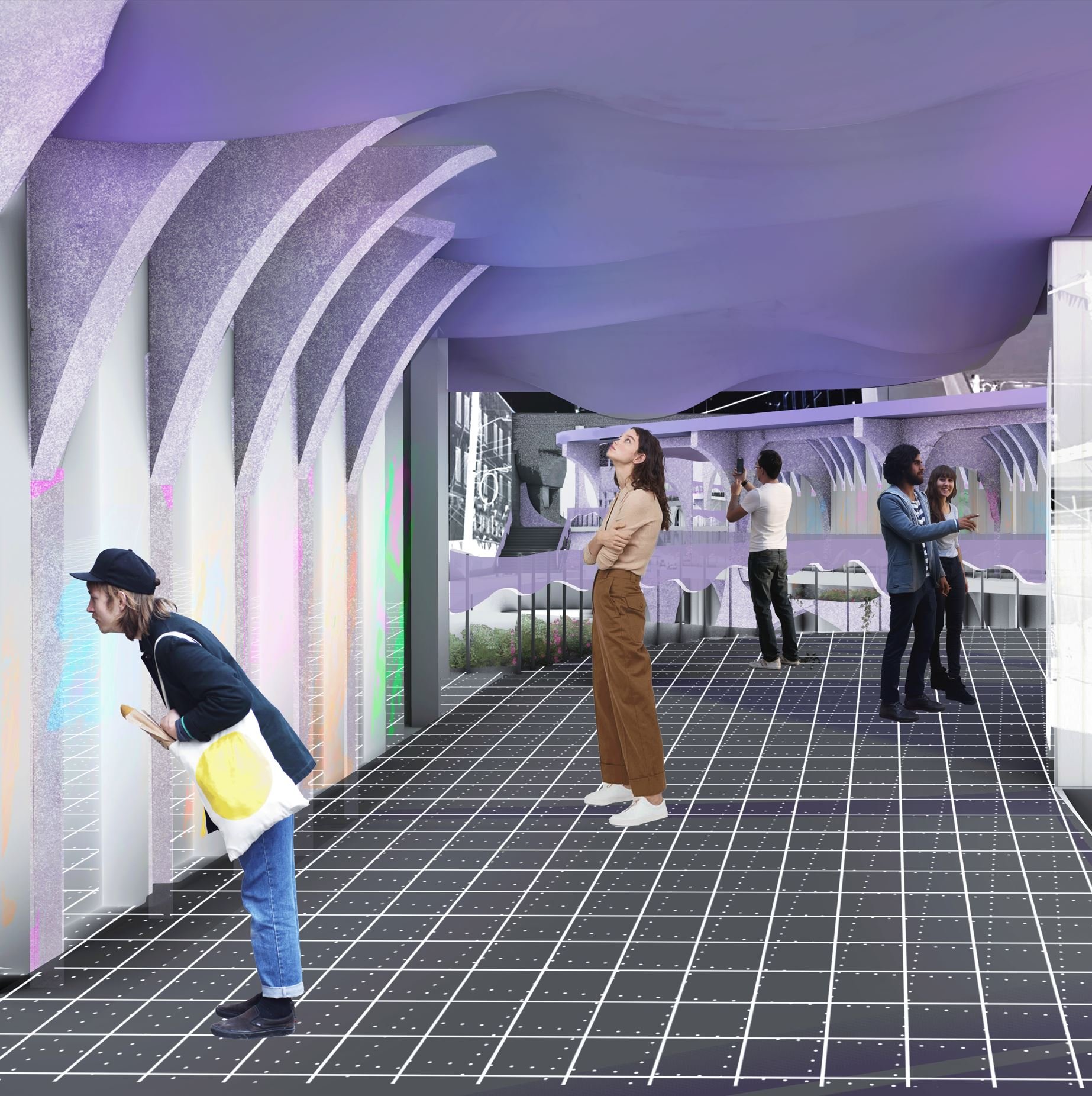
south entry
collage
initial mapping excercise

When beginning my research I started looking into things that make the city feel unsafe or unwelcoming as a woman, things like lack of lighting, tall facades without entries, vacant lots, underused space under overpasses and lack of sidewalks/pedestrian infrastructure. This led me to picking my site at the heart of portland’s central east side; on 3rd avenue, spanning the blocks between Morrison and Yamhill.
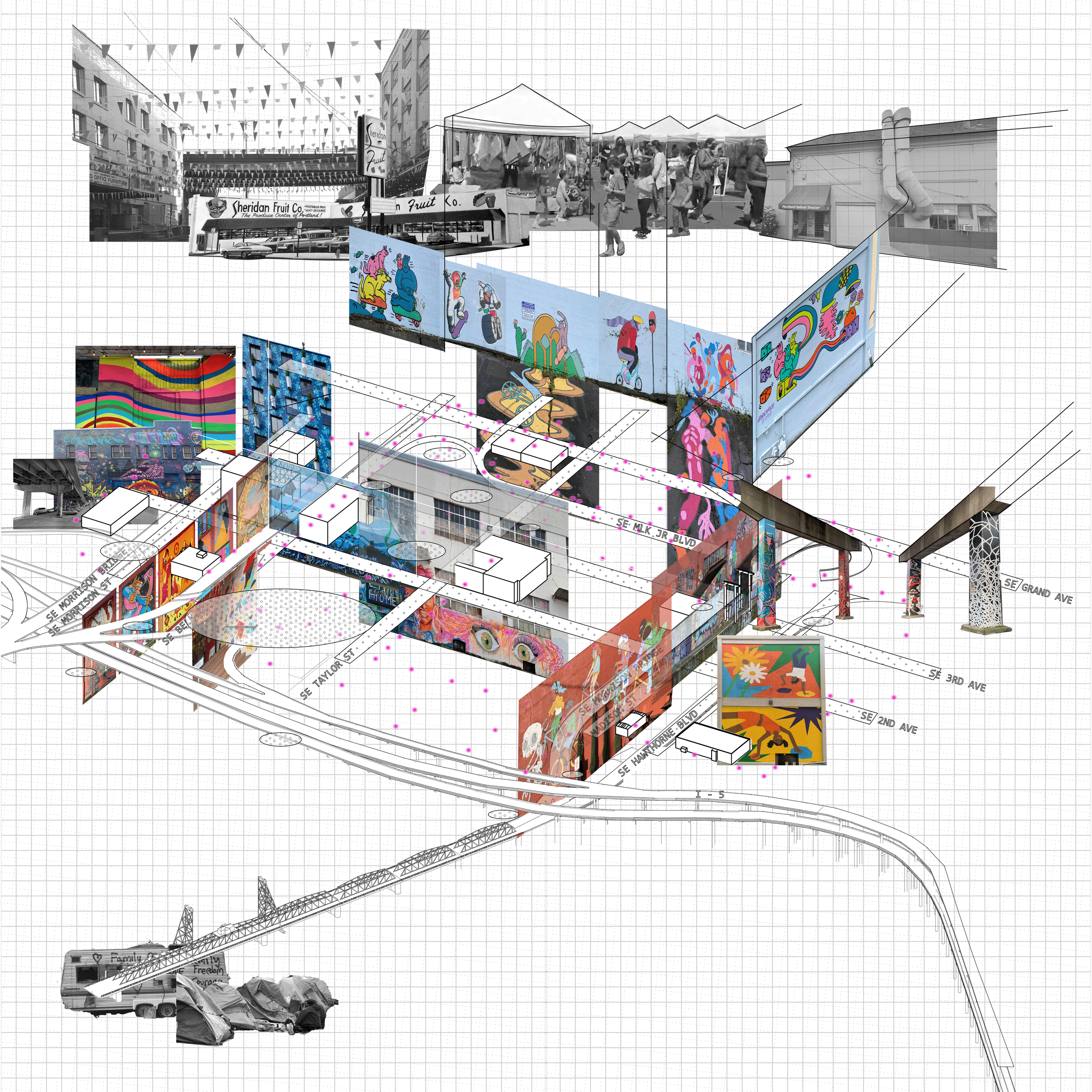
mural mapping

The Central East Side is notorious for having little existing sidewalks, is extremely car-focused, and has two large overpasses passing over it. Simultaneously, this site has a bright and vibrant art culture: Portland Street Art Alliance has been commissioning local artists to paint murals in attempts to make this the “mural district” within Portland. In addition, the neighborhood has a thriving flea culture and underground art culture. This “underground culture” inspired me to research more into queer art forms such as drag (while now it’s become much more mainstream) historically, queens and other performers come out at night, and drag events (Balls and Pagaents) originated as an underground scene where Black and Latinx gay, trans and queer people developed a thriving subculture, where they could express themselves freely and find acceptance within a marginalized community. Drag balls were considered illegal and taboo to the outside world in the early 20th century, which drove the competitions underground (and also undoubtedly added to their appeal). Attendees were invite only, or knew someone who is there or competing. Drag balls evolved into House Balls, which became the birthplace of voguing.
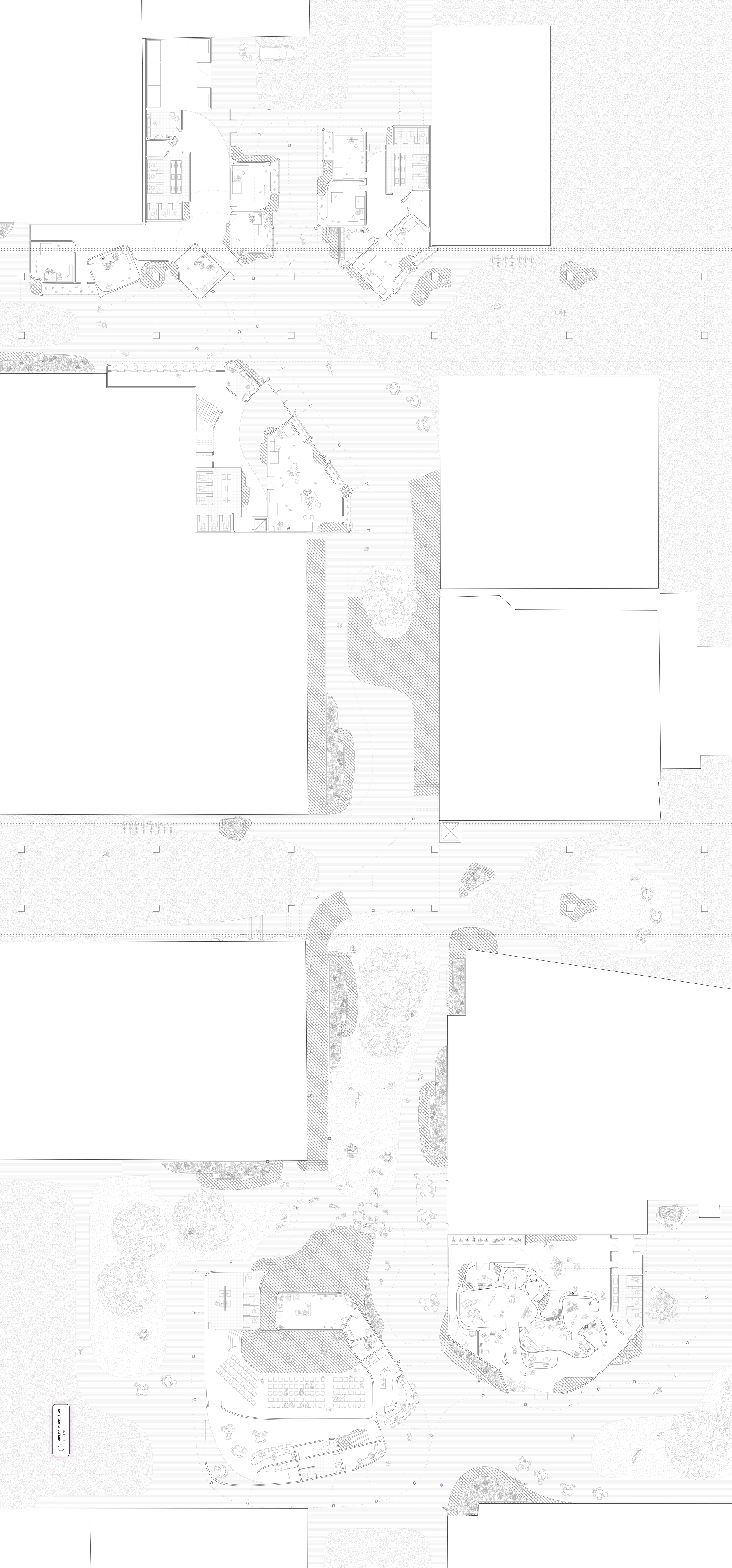
level 01 plan
level 2 floor plan
section
show thumbnails